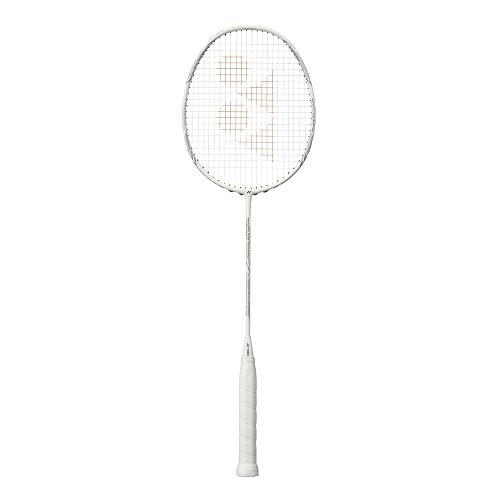
Used the Astrox 100ZZ and started at a slightly lower string tension to get used to it. Says it punishes mishits and rewards a smooth, loose swing that tightens only at impact, and that it takes a few sessions to adjust.
switched from my 88D Pro to save my shoulder and the jump in hand speed is real. drives and flat exchanges at the front are way quicker, and i finally get the racket up in time when someone smashes at my body.
but from the back it just doesn't hit through the shuttle like a heavier frame. my smashes come off quick but they don't drop steep and the other pair picks them up all night. strung at 26 lbs, might try going lower.
decent racket, just the wrong one if you're the guy who lives in the back court
Switched from an Astrox 77 Pro a couple months ago, strung at 26 lbs with BG80. Smashes are the whole reason to own this thing, they come down steep and heavy without me having to force anything. The head weight does catch me out on fast drives in doubles though, and my shoulder is tired by the third game. Off-centre hits get punished, so if your technique is shaky look elsewhere. Worth it if you're an attacker who is fit enough for it.
Picked this up because I'd been playing with a stiff head heavy racket and my shoulder was complaining after every Thursday doubles night. The Arcsaber 7 Play is the opposite. It's light, it swings through quickly, and defending flat drives and fast exchanges at the net is honestly easier than anything I've had before. The sweet spot feels huge, even my sloppy off-centre clears still go back.
What it doesn't do is give me free power. After about 8 months my smashes are clearly softer than my partner's, and when I try to hit harder it feels like the frame just bends instead of snapping. Fine if you're a defensive or all-round doubles player or still learning, probably not what I'd buy again once the technique improves. Three stars from me because it does exactly what it says but I want more bite on the smash.
Bought the Thruster F Claw Ultra and loves it: it finally gives them the power they wanted on backcourt smashes, clears are effortless, and it is nimble with good control at the front.
Tried the Auraspeed 100X Ultra recently and disliked it: the Free Core handle gives very little feedback, and smashes felt far less satisfying than with the Astrox 88D.
A heavy smasher about a year into the game plays the Thruster Ryuga TD strung with BG65. Enjoys the raw smash power, but the very head-heavy balance and demanding shaft punish late shots, defence against fast drives and reactions at the net.
An upper-beginner singles and lower-intermediate doubles player who owns the Thruster F Claw Ultra finds it not demanding: stiff but whippy, with a forgiving sweet spot thanks to the larger head. Power comes easily from the head weight, though it gets a little tiring and they feel they only get about 80% of their power on clean hits.
Compared with the original Astrox 77, finds the 77 Pro slightly more head-heavy and stiffer, with more punch from the back court while staying quick for flicks and pushes at the net. Also liked having it in G6 for more control at the net.
A beginner-to-intermediate doubles player has used the Astrox 88 Play since taking up the game a year ago and loves it: versatile, with plenty of power when attacking. Now looking for something similar with a bit more control.
Felt stiffer and heavier in the head than even the original Ryuga. His 4U sample swung heavier than his 3U sample, and he found the racket unforgiving when his timing was off.
Felt heavier in the head than the standard Ryuga II and gave more raw power without making it easier to swing. Contact was softer than on the original Ryuga, and he suggested trying the 4U if the extra weight felt demanding.
4U Auraspeed 100X Ultra owner: faster drives and better defence than the 88S Game and light, even balance, but vibration, poor stability, clears lacking power and a smaller sweet spot.
The 4U was easy to maneuver and felt solid but soft on contact, with enough rebound to keep long sessions comfortable. Off-centre hits sometimes sent a distracting vibration through the shaft, and the tester wouldn’t choose it for outright smash power.
This owner of the third-generation 88D Pro with BG80 finds control, net play and smashing fantastic, but it needs a lot of energy and good technique, and clears feel weak after about five in a row.
Broke their Nanoflare 1000Z on a clean hit and thinks an earlier clash had created a weak point. Treats rackets as long-lasting consumables rather than something that lasts forever.
This Dutch-league player with tennis elbow finds the flexible Astrox 77 Play, strung at about 22 lbs, forgiving on the arm, though the BG65 string feels dead.
After a month with the third-generation 88D Pro, this player found smashes and clears great, but the extra head weight made them late on drives, defence and net play.
Owns the Astrox 88S Pro and 88D Pro (3rd gen) and mainly uses the 88S Pro: lighter and easier for drives, defence and net play, but short of backcourt power, which they partly put down to technique. After a month on the 88D Pro they felt late on drives and defence.
A high-intermediate UK league player who normally uses the Astrox 88D Pro found the Astrox 77 Tour effortless on clears and smashes and easier on the arm in drives at first. Over time the more flexible shaft made placement and defensive timing harder, so it is now a backup for days when their footwork is sluggish.
An upper-intermediate player moved from a 3U Axforce 100, which felt strong and fast, to a 3U Astrox 99 Pro (3rd gen). After six months their smashes are weaker, defence is worse and drives near the net are a struggle, though they want to keep at it.
Having tried the Yonex and Victor lines, likes the 3U Thruster Ryuga II Pro most: a normal head-heavy racket that feels like a beefed-up Astrox 88D gen 3, whippier with a heavier smash but still quick enough for doubles, and the plastic handle is easy on the shoulder.
Tried the Arcsaber 7 Pro after two and a half years with an Arcsaber 11: noticeably worse control, but more powerful and a little quicker in fast exchanges.
A player of more than eight years loved everything about the Nanoflare 700 Pro (head-light, medium-flexible, effortless swing and clears) but broke it after a few months and doubts it is worth buying again for that reason.
The 5U, G6, mid-flex frame felt very light in the hand but that was immediately offset by a strongly head-heavy balance. It was quick, though not dramatically quicker than some 4U speed frames such as an Auraspeed 90K Metallic, and still had more punch than some 4U options, including an Auraspeed 100X Ultra. Mid-flex plus the heavy head worked well enough that rear-court play remained manageable. Aimed at a lighter, easier-power game rather than at a heavier singles or rear-court role.
Used the Nanoflare 1000Z for a year and was happy with it until it broke. Before that they broke four Victor rackets (Thruster and Auraspeed 100X Ultra) in six months.
A control player with good downward smashes used a 3U Nanoflare 1000Z for three years and loved it until it broke. Found the Nanoflare 800 Pro's shaft too soft by comparison.
After six months with the Nanoflare 800 Pro (Exbolt at 24x25 lbs), is not very happy: a little stiff and unforgiving, with so-so reflexes and defence, though their jump smash is great with it. Wants easier power.
Smash power is decent but clearly down on the Axforce Cannon, and generating the same pace takes more effort. Drives and flat exchanges were quicker than expected for a head-heavy frame and can produce good power with sound technique, though not at Cannon or Halbertec Motor level. Clears and lifts get little help from the racket and need good technique to reach the baseline. Defence felt heavier and slower than the Cannon and can be a struggle. Drops and slices are controllable with a bit of technique, and net dribbles and cross-court nets were straightforward, though net kills were only average and unforgiving of mistiming. The 4U felt heavy, especially in defence, with the 5U suggested as an easier option. It suits attacking intermediate players on a budget more than beginners or defensive and rally styles; doubles backcourt smashes work, but defence can become a problem.
Played the Nanoflare Nextage about three times and switched back to their Astrox Nextage mid-game each time: it felt too light, so they swung too early and missed shuttles they normally reach.
After the Arcsaber 7 and 11 Pro and Li-Ning Calibar, the Nanoflare 700 Pro is the best-feeling racket of their 20 years, making smashes, clears and finesse consistent and improving deception timing.
Tried both the Astrox 100ZZ Kurenai and the 100VA ZZ in 4U: the VA felt less head-heavy and more user-friendly, with faster swing speed, manoeuvrability and control.
An intermediate doubles player who owns the Nanoflare 1000 Game and Arcsaber 7 Tour finds the 1000 Game fast, medium-stiff and easy for power, and suggests a stiffer string if it feels too flexible.
Bought the Nanoflare 800 Pro after reading a review and loves it; it fits them very well. Now wants a second racket with more backcourt smash power for mixed doubles.
Reviewing four affordable fast rackets, finds the 3U BladeX 700 a slightly head-light all-rounder with a great feel: adequate power, strong in flat exchanges and tight net shots, though the slowest of the group and a little uninspiring at times.
Owns the Astrox Nextage in both colourways: about 80% of a pro racket's performance at a third of the price, forgiving thanks to the medium flex, and fine for singles and doubles.
Compared with the Arcsaber 11, finds the Thruster F Claw Ultra a little more head-heavy, with a bit more power and slightly slower, but still a good all-rounder.
Bought the BladeX 800 Speed in 4U and finds it fast with decent control, but a bit short of smash power from the back. Feels medium-stiff rather than the hard flex Li-Ning states, compared with their Astrox 88D Pro 3rd gen.
Has used both an Astrox 99 Pro and the Thruster Ryuga Metallic; the 99 felt amazing but tired them out, so the less head-heavy Ryuga Metallic is now their main racket because it defends better.
This player calls the 100ZZ an awesome racquet: more power than the 88D Pro and rewarding control, but less forgiving with its compact head and noticeably tiring on the arm.
Tried both the Auraspeed Fantôme F and the Fantôme (J): the F is more head-light and more all-round, good if power isn't a problem; both are good from the rear court.
A doubles player who moved from the Thruster Ryuga Metallic to the 4U Astrox 99 Game (3rd gen) now rates its power above the Ryuga: effortless clears and lifts, crisp drives and flat exchanges, though net drops feel sluggish and front-court play is demanding.
Felt surprisingly light in the hand for the smash power on offer, with pace coming more from swing speed than from a heavy head. Drives and flat exchanges were easy even for less experienced hitting, and the frame was described as very forgiving. Clears and lifts reached the baseline accurately with a little technique, more easily than other frames in this price band, though the 6U struggled there because it is simply very light. Defence was manoeuvrable enough to get under fast smashes, with useful blocks. Drops and slices were precise when technique was there, and net dribbles, cross-court net shots and net kills were a strong point. Friends’ frames survived minor clashes over long use.
The third generation still hit with plenty of power in a short court test, but its shaft felt more forgiving than the 100ZZ when contact wasn’t clean. It was easier to control in flat play and defence, though the head weight still called for good technique.
Gave very direct feedback and rewarded clean timing in a short on-court comparison with the third-generation Astrox 99 Pro. The stiff shaft and head weight made flat exchanges and defensive reactions harder when timing was off.
Copied Liang Weikang's setup (Exbolt 65 at 28 lbs): the Nanoflare 800 Pro is easy to use with insane, effortless power and is easier on tennis elbow than the 100ZZ, which needs more effort.
After trying the 77 Pro, 88D Pro 2nd and 3rd gen, 100ZZ, Bladex 900 and Nanoflare 800 Pro, this player names the Astrox 77 Pro as their clear favourite.